Table of Contents
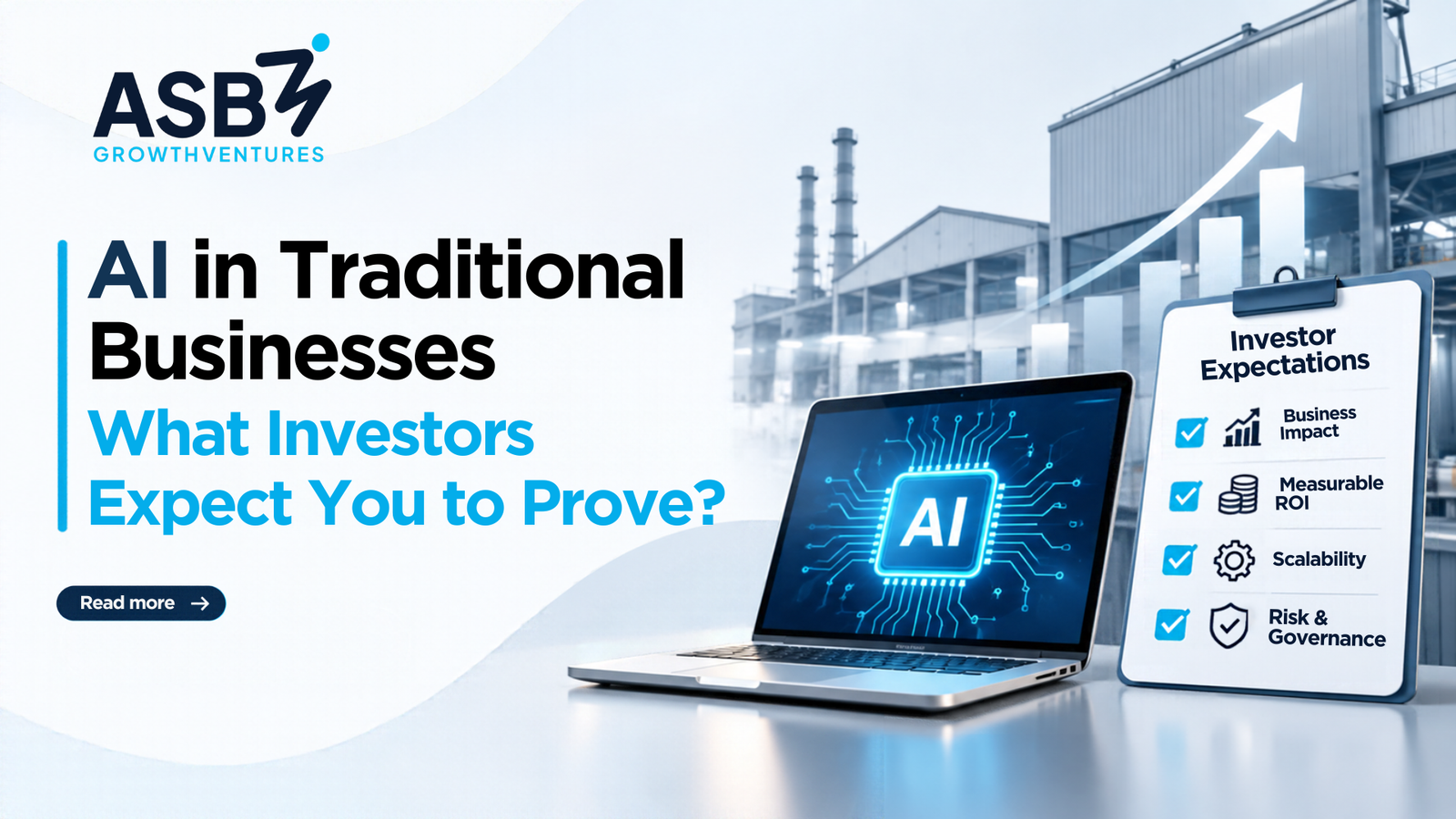
ToggleAI in a Traditional Business: What Investors Will Ask You to Prove
Using AI in your business and proving it to an investor are two very different jobs. Most traditional companies have only done the first one. If you’re planning to raise money or list, the second one is what the room will spend its time on.
Below are the questions investors ask most, the mistakes founders keep making, and what to have ready before you walk in.
1. Why "We Use AI" Doesn't Land Anymore
Imagine a textile exporter in Surat who has been in the business for forty years. Recently, his team introduced a new tool that helps predict which fabric orders are likely to be returned. As a result, returns decreased significantly, and the merchandising head was thrilled. The owner was so impressed that he even included it on slide six of his presentation to investors.
But the first investor call and the subsequent ones are a completely different story. How much did returns drop? vs some number, who verifies the tool when it fails to deliver? He had a feeling it was working. He just had no numbers to back this up. This happens all the time. Just a few years ago, all you had to do was say your company used “AI” and people would want to meet with you again. Now, it’s not that easy – you’ll get a nice smile and a list of tough questions instead.
There’s been quite a bit of burn in the investor community when it comes to marketing “AI powered” investment strategies. In March 2024, for example, two investment advisors were collectively fined $400k by the US SEC for misrepresenting the extent to which AI was actually used in their respective investment strategies and the term “AI washing” has stuck around since. Nobody wants to invest in a company that’s just a fancy spreadsheet with a catchy slogan.

2. What Investors Will Ask You to Prove
Proof 1: Is the AI really in the business?
Every investor has his/her own style but when asking the same type of questions, the inquiries below are basically the same.
Proof 1: Is the AI really in the business?
“WE USE AI ACROSS THE BUSINESS” Does not reveal anything. Present PROCESS, TOOLS and HUMAN USER of AI in operation. Be ready to show:
• The exact process it touches, like demand planning, quality checks, credit scoring or route planning
• Whether you built it, bought it, or you’re using a vendor’s tool
• How many transactions or people it handles today
• What was replaced by this function and is it still active somewhere? You can be certain they will believe the AI is nowhere to be found if you cannot point at it.
Proof 2: What changed in the numbers?
This is the major component. Show before numbers and after numbers. Show the reader the ‘baseline’. Show how much waste there was before implementation and how much there is after implementation. Show how turnaround time decreased in days. A saved number without a starting point number is merely a story.
Did you actually roll this out 6 months ago? Yes, then share the early data with the appropriate context. What hurts is a big claim with nothing under it.
A small saving you can verify beats a large one you can’t.
Proof 3: Whose data is it, and do you have the right to use it?
The data you collect is also going to be scrutinized. Where did you get the data from? Who created it and who is the owner of it? Did you collect the data with the customer’s consent while it was in use? Most traditional businesses get stuck at this point because all their data is in Tally, a dozen Excel sheets, some WhatsApp groups and a single laptop.
There’s a legal angle as well.
Proof 4: What happens when it gets it wrong?
No AI tool is ever 100% perfect. Every investor knows that. They are not searching for the perfect business. They want to see how you plan for failures. Who will review the output of AI before it reaches customers? Will there be a log of all AI decisions? What will happen when the system fails for a week? In areas such as lending, insurance, healthcare etc. which are subject to extensive regulation, this issue generates a lot of stress. A written process is a lot better than empty promises.

Proof 5: What does it cost, and who keeps it running?
Also expect to be asked for the amount of money already spent, for a budget for the future and for a cash flow plan. Most importantly: who are the people? If one single person, the engineer who joined two years ago, holds the whole thing together, then that person’s risk will be factored in.
Be specific about any capital earmarked for AI initiatives. Once those funds are included in the offer document as an object of the issue, the issuer must report on their utilization every quarter. Broad descriptions, such as “technology upgrades,” will not withstand due diligence.
3. Mistakes Founders Keep Making
Most of these are easy to fix once you spot them.
- Calling basic automation AI. An auto-reply or an Excel macro isn’t AI. A banker will work that out in a day.
- Quoting the vendor’s case studies. Those are about other companies. Your numbers have to come from your own books.
- Skipping the baseline. If nobody measured the process before the tool arrived, you can’t prove anything moved.
- Hiding failed pilots. A trial that flopped, plus what you learned, makes you look careful. Hiding it makes you look risky.
- Keeping the knowledge in one head. If only one person understands the system, write it down before someone asks.
A modest AI story told straight holds up better than a big one that cracks on the second call.
4. Getting Your AI Story Ready
A perfect setup isn’t required. Something organised that you can hand over without scrambling is plenty. Start about three to six months before due diligence, not the week before. Five things to put together:
- Proof: a one-page summary per AI use case, with the baseline, current numbers and time period
- Data: a simple map of where it comes from, who owns it and what consent you hold
- Controls: a written process for reviewing outputs, logging errors and switching to manual
- Money: spend so far, planned spend, expected return and timeline
- People: who runs each tool and who can step in if they leave
Park all of it in your data room so it’s there when the questions start. Founders who do this early tend to have calmer investor meetings, mostly because they’ve already asked themselves the hard questions.
5. How ASB Growth Ventures Supports You
At ASB Growth Ventures, we work with promoters, CFOs and boards preparing to raise capital or go public. Many of them run traditional businesses that have started using AI and aren’t sure how to present it. We help you tell that story so it holds up under questioning.
Here’s where we usually step in:
- A readiness check across financial, governance, operational and strategic areas through our Market Readiness Accelerator
- Building the proof, data and controls documentation investors ask for
- Valuation and capital structuring that reflects your real position, AI spend included
- Capital utilisation planning, so the money you raise is tied to clear, defensible objectives
- End to end support through our IPO consultancy services, from first assessment to listing
If you’re wondering whether your AI story would hold up in front of an investor, send it our way. We’ll take a look and tell you straight.