Table of Contents
ToggleProfitable on Paper, Short on Cash: Is Your SME IPO-Ready?
Quick question. Did your accounting firm ever assure you that your financial year was really great?
Afterwards, you took a look at the bank account and it came over to you as wait, who spent this?
Honestly, there are many more individuals like you in such condition. SME owners often go through exactly the same dilemma: they make the money, yet at the time of payment, almost no money is left.
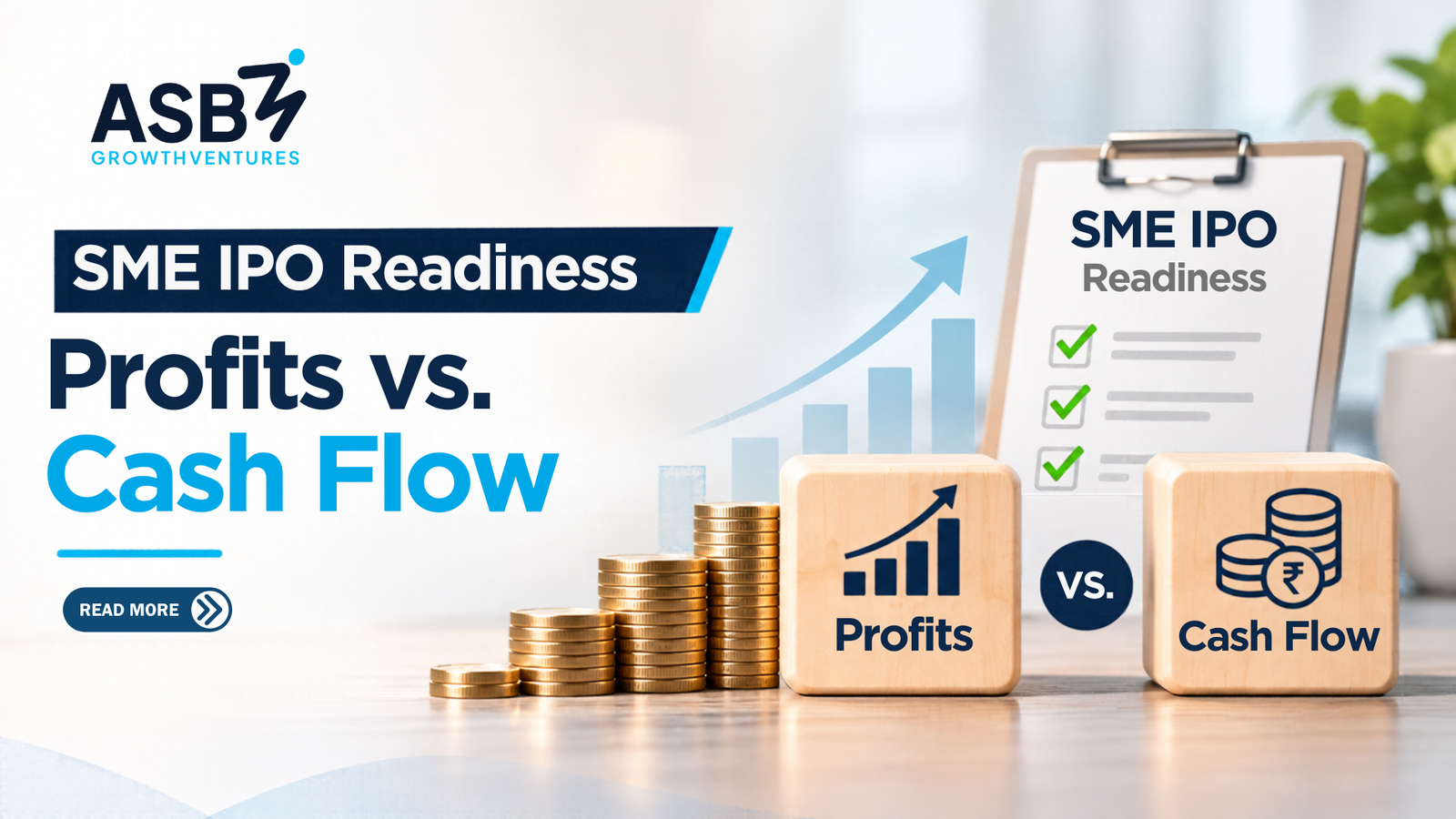
Now include an IPO, and the significance escalates even further. Merchant bankers, the stock exchange and investors will be primarily interested in the figures presented regarding profit and cash, and if the reported levels do not seem aligned, they will find it out eventually. Therefore, here is a list of some important things you should review prior to disclosing any document.
1. Profit and Cash Are Two Different Things
Profit is merely an accounting measurement. Whereas cash refers to the money available in your bank account at the moment. Imagine you credit a customer after making a sale, the revenue immediately appears on your accounts. However, the customer could pay the money only 90 or 120 days later. So in the mean time, you still need to take care of paying salaries, suppliers, GST, rent, and EMI payments.
Cash flow is the lifeblood of any growing business. The more you grow, the more demands will be placed on your cash reserves.
For example: each new order will require an increased amount of raw materials. So, you will be having stock which is higher than the previous level. And also customers will get more credit.
Thus, the cash requirement for keeping the business operation running smoothly increases as growth happens at a faster rate.
Imagine a packaging company that sells about ₹40 crore annually and has a EBITDA of ₹3 crore.
Besides that, their payment terms allow about 120 days on an average for their customers to pay. Hence, at any particular time, around ₹13 crore of their sales is being held by customers. The accounts show strong revenue. Yet, the owner is still chasing a bank for a higher overdraft limit.

2. Find Out Where Your Cash Is Stuck
Before anything else, work out the usual suspects. Most cash problems hide in a handful of places:
- Receivables: how many days customers really take to pay, not what the credit terms say
- Inventory: slow-moving or obsolete stock that is still valued in full
- Advances to suppliers: money paid out early that has not turned into goods yet
- Loans and advances to promoters or group companies: these draw a lot of questions
- Capex funded from working capital lines: a short-term loan paying for a long-term asset
Calculate your debtor days, inventory days and creditor days. Put them together and you get your cash conversion cycle. If that number keeps getting longer every year, you have found your problem.
3. Check the EBITDA Test First
This may appear to be something that is easy to describe and understand but is quite often misinterpreted. The changes in SEBI regulations (SEBI ICDR Amendments) of March 2025 require a small medium enterprise (SME) contemplating an IPO to be able to show an operating profit (EBITDA) of least ₹1 crore in at least two of the three financial years preceding the submission of draught offer document. Stock exchanges such as NSE Emerge have put the same standard into operation as part of their own guidelines.
Loss-making businesses or those only barely surviving will probably not be allowed on the SME track for now. On the other hand, if you clearly exceed the limit, that’s a positive sign. But make sure the EBITDA number doesn’t actually conceal other income or a single-time profit gain. Has the figure appearing in management accounts been the same as the figure in audited statements? A gap between the two is the kind of thing a lead manager will find in the first week.
4. Read Your Cash Flow Statement Like a Banker Would
Most founders go straight to the profit and loss account. Flip to the cash flow statement instead. Compare your operating cash flow with your EBITDA over the last three years.
If EBITDA is positive but operating cash flow stays weak or negative year after year, expect questions. There is no magic ratio you must hit, but you do need a clear and honest explanation. Look at these as well:
- Is your borrowing rising faster than your sales?
- Can you cover interest comfortably from operating profit?
- Are you rolling over short-term loans just to fund day-to-day running?
Investors read this statement closely. It tells them if the business can fund itself or keeps leaning on lenders.
5. Be Honest About Where the IPO Money Will Go
Working capital is a legitimate purpose for raising funds through an IPO, and many small and medium enterprises do raise capital with this aim. What you need to do is justify the amount with a detailed working capital projection, not a mere estimate. SEBI has also capped the amount for general corporate purposes at 15% of the issue size or ₹10 crore, whichever is lower, so you simply cannot put a large, undefined figure there.
In simple words, another point here: if you don’t have enough money to get out of cash flow difficulties because collections are not doing their job, an IPO is not the way to go. It just moves the problem forward and presents it to the public shareholders. Tighten your credit policy to be strict and get a hold on all the overdue payments well before you even make the submission. Even improvements as small as six-month collections will reflect positively in your financial statements.

6. Clean Up Before Due Diligence Starts
Due diligence goes through everything. The more tidy your records are, the faster and cheaper the process gets. Start with:
- Related party transactions: mainboard norms now apply to SME-listed companies, so document these properly
- Promoter and group loans: know what is outstanding and have a plan to settle or explain it
- Statutory filings: GST, TDS and PF returns should reconcile with your books
- Audited financials: three years of consistent, reconciled numbers
- Contracts and licences: key customer agreements and compliance certificates in order
The draft offer document is also open for public comments for 21 days. Whatever is in it will be read by people who have no reason to go easy on you. If you can answer yes to the ₹1 crore EBITDA test, your cash flow follows your profit, and every promoter balance can be explained in one sentence, you are in good shape. If not, a few months of focused clean-up before filing will do more for you than rushing.
How ASB Growth Ventures Adds Value
At ASB Growth Ventures, we collaborate with business owners who are interested in becoming public and want to get it right from the very beginning. We begin by taking a transparent view of your financial situation, working capital position, and how compliant you are. After that, we get involved in capital structuring and valuation, transaction advisory, and IPO preparation, and we let you know about the weaknesses early enough that they do not become issues during due diligence. Our Market Readiness Accelerator is for businesses needing to make a number of improvements prior to submitting their filing.
Profit gets you through the eligibility door. Healthy cash flow is what keeps investors comfortable once you are inside. Get both right, and the IPO conversation becomes a lot easier.